
Growth Guide
Why Estheticians Lose Clients After One Visit
The real reason first-time clients ghost is not your skill - it is the gap between a great facial and a reason to come back. Treatment Plans close that gap.
Thirty days for $1, then $139 a month with four team members included.
Why a great first visit so often stays the only one
Many first-time facial clients never return. For estheticians, that means a large share of every new-client marketing dollar goes to waste. You spend on ads, SEO, and referral incentives to get someone through the door, deliver an excellent service, and then never see them again.
The instinct is to blame the client - they were price shopping, they were not serious, they went somewhere cheaper. But it is usually a structural problem, not a client problem. Most estheticians finish a facial, say 'you should come back in four weeks,' hand over a business card, and hope for the best. There is no next step, no plan, no commitment mechanism.
Without a defined treatment plan, the client leaves thinking 'that was nice' instead of 'I am on session one of six.' The difference between those two thoughts is the difference between a one-time transaction and a $900 treatment plan enrollment. The fix is not better facials - it is a better system for what happens after the facial ends.
Five retention fixes that turn first visits into treatment plans
- 1
Conduct a skin assessment before the first treatment
Start every new client with a skin assessment that maps her concerns, history, and goals, then share the skin plan (recommended treatments and home routine) she can reopen at home. This positions you as a clinician, not a service provider, and gives you the data to recommend a specific treatment plan rather than a generic follow-up.
- 2
Present a treatment plan before they leave the room
While the client is still in the chair, walk them through a 3-6 session treatment plan tailored to their assessment. Show the phases, explain what each session targets, and give them a total price. A clear path forward gives clients a reason to rebook that 'come back whenever' does not.
- 3
Book the next session before checkout
Do not let the client leave with a vague intent to rebook. Have your booking system open at checkout and schedule their next appointment on the spot. Attach a deposit if your policy allows. Booking while the client is still in the room is far easier than winning her back with a text days later.
- 4
Automate a post-visit follow-up within 24 hours
Send an automated message the next morning - not a sales pitch, but a check-in on their skin and a reminder of the homecare steps you discussed. This reinforces the professional relationship and keeps your practice top-of-mind in the days after her visit.
- 5
Use automated nudges to catch clients who drift
If a client does not rebook within their recommended window, an automated reminder based on their treatment plan and visit cadence can bring some at-risk clients back. The key is personalization - a message that references their specific treatment plan and next phase, not a generic 'we miss you' blast.
Illustrative planning scenario — not a customer result
Planning math: what a higher return rate is worth
Say you see 20 new clients a month and 8 of them (40%) come back for a second visit. If consultations, a presented treatment plan, and booking the next session at checkout brought that to 12, you would have 4 more returning clients each month. If each of them books 3 more visits at $150, that is $1,800 from one month of new clients. Track your own first-to-second-visit rate for a few months before and after the change to see where you land.
How this works in SpaSphere
Treatment Plans
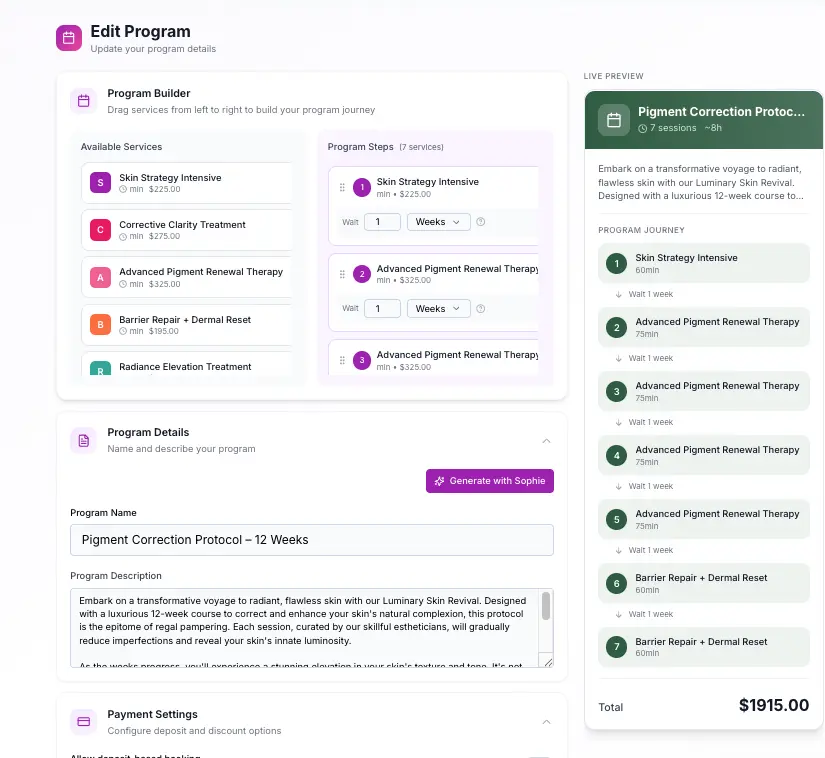
Create structured treatment plans that give clients a reason to commit beyond one visit - with phased scheduling and progress tracking built in.
SOAP Notes
Document skin assessments in structured notes that sit on the client record, ready before each session, so you never lose continuity.
Automated Reminders
Send post-visit follow-ups and rebooking nudges automatically, and a 'Your Next Session is Ready' email when her next plan session opens.
Sophie AI Coach
Churn Prevention flags clients who have fallen out of their usual visit rhythm, and Sophie drafts a win-back email in your brand voice. Nothing is sent until you choose to send it.
Frequently asked questions
Is it normal to lose so many first-time clients?
It is common. How many return depends heavily on whether the practice has any structured follow-up. Track your own first-to-second-visit rate so you know your starting point, then measure it again after you add a treatment plan conversation and checkout rebooking.
What if I am an experienced esthetician and still losing first-time clients?
Skill is rarely the issue. Most one-and-done departures happen because the client had a good experience but no compelling reason to return on a specific timeline. A treatment plan creates that reason. Even highly skilled estheticians often find more clients return when they add treatment plan structure to their consultations.
How do I present a treatment plan without being pushy?
Frame it as clinical guidance, not a sales pitch. After the skin assessment, say: 'Based on what I see, here is what I would recommend over the next eight weeks.' Walk through the phases and outcomes. Clients respond to expertise and clarity - they feel pushed when they sense a hard sell without substance behind it.
Does rebooking at checkout really make that much difference?
Usually, yes. The client is in her highest-trust, highest-satisfaction moment right after a great treatment. Capturing that moment is one of the highest-leverage retention actions you can take.
Related tools
More growth guides
Carry today's treatment into her next visit.
SpaSphere keeps your assessment, treatment plan and home-care recommendations with your client, so the next appointment starts where this one ended.