
Growth Guide
How to Turn Clients into Treatment Plans
The shift from booking facials to enrolling clients in structured treatment plans is one of the highest-leverage changes an esthetician can make. Here is exactly how to do it.
Thirty days for $1, then $139 a month with four team members included.
One-off facials keep you busy but never build momentum
There is a version of esthetics that looks successful from the outside - a full calendar, a steady stream of clients, decent revenue. But underneath, it is fragile. Every week starts from zero. Every client is a single transaction. Cancel two appointments and the whole week is in the red.
The core issue is that most estheticians are selling time, not outcomes. A 60-minute facial is a commodity that clients compare on price. A 6-session acne clearing treatment plan is a transformation that clients compare on results. The economics are completely different: the facial generates $150, the treatment plan generates $900 from the same client with lower per-session acquisition cost.
Treatment Plans also solve the clinical problem. You cannot meaningfully address acne, pigmentation, aging, or barrier damage in one session. When clients book one facial at a time, you are forced to treat reactively - whatever shows up that day. Treatment Plans let you treat progressively, with each session building on the last, which leads to better outcomes and happier clients who stay longer.
The consultation-to-enrollment system
- 1
Restructure your menu around treatment plans, not services
Instead of listing 12 different facials, group your treatments into 3-5 outcome-based treatment plans: acne clearing, anti-aging, brightening, barrier repair, bridal prep. Each treatment plan has defined phases, session counts, and pricing. Individual facials still exist as an entry point, but the menu leads with treatment plans.
- 2
Use the first session as a diagnostic, not just a treatment
Turn every new-client appointment into a combination of treatment and assessment. Spend the first 10-15 minutes on a skin assessment, take photos with consent, and let the skin plan you share become the start of her treatment plan. This data becomes the foundation for a personalized treatment plan recommendation that feels clinical, not sales-driven.
- 3
Present the treatment plan visually before the client checks out
Show the client their assessment findings and walk them through the recommended treatment plan: phases, expected timeline, session count, and total investment. Use a digital display or printed overview - a visual walkthrough is easier to follow than a verbal recommendation alone. Let them see the journey, not just hear about it.
- 4
Offer enrollment incentives that protect your margins
A 10-15% discount off the à la carte total for upfront treatment plan payment is a good rule of thumb. You can also offer a complimentary add-on (LED session, product sample kit) for enrolling on the spot. The incentive should feel valuable to the client but cost you very little in actual margin.
- 5
Keep the plan moving after enrollment
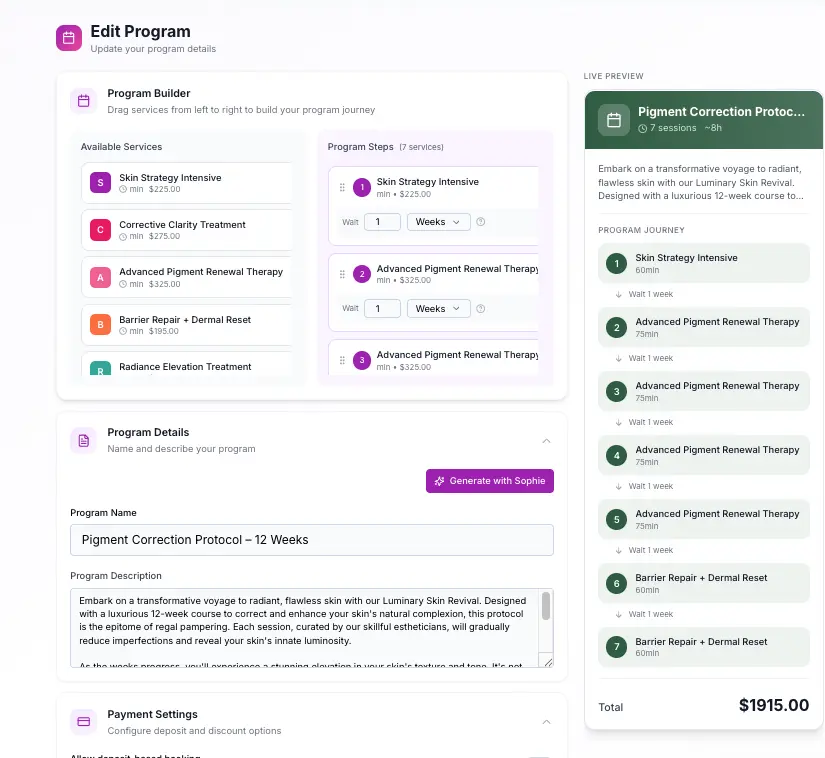
Once she enrolls, book her next session before she leaves and keep the spacing that protects results: a reminder when each session is due, progress she can see between visits, and the maintenance conversation as the plan nears completion. In SpaSphere, each step has a minimum wait; once it has passed, she gets a 'Your Next Session is Ready' email and a Book button on her portal.
Illustrative planning scenario — not a customer result
Planning math: an enrollment shift in numbers
Say your practice sees 40 new clients a month, each booking a single facial at $145. If 35% of them, 14 clients, enroll in a plan averaging $780 instead, those 14 clients bring $10,920 in plan revenue compared with $2,030 for one visit each. Plan revenue arrives over several months as sessions are delivered, and you need open slots to serve it. Change the new-client count, enrollment rate, and plan price to match your menu.
How this works in SpaSphere
Treatment Plans
Sequence sessions with a minimum wait between them, track each step, and let her follow the plan on her portal between visits.
SOAP Notes
Structured skin assessments that document findings, attach to client profiles, and surface before each session to keep treatment plans on track.
Online Booking
Clients book single sessions online. You enroll her in a plan at checkout or from her profile, and each step's Book button opens your booking page once its wait has passed.
Client Management
Track each client's treatment plan progress, visit history, SOAP notes, and product purchases in one unified profile.
Frequently asked questions
What percentage of clients typically enroll in treatment plans?
There is no reliable benchmark, so track your own enrollment rate from the first month. The rate depends on how well the consultation is structured and whether the treatment plan is presented visually with clear pricing.
Do I need to stop offering individual facials?
No. Individual sessions remain important as an entry point for new clients and for existing clients who want maintenance without a treatment plan commitment. The goal is to make treatment plans the primary recommendation, not the only option.
How do I train myself (or my team) on the enrollment conversation?
Practice the flow: assessment findings, treatment plan recommendation, visual walkthrough, pricing, enrollment. Script the transition sentence - something like 'Based on what I see today, here is what I would recommend as a plan.' The more clinical and specific your recommendation, the less it feels like a sales pitch.
What if a client finishes a treatment plan and does not want to start another?
Transition them to monthly maintenance at full à la carte pricing. The treatment plan established the relationship and delivered results - maintenance keeps them on your calendar. Many treatment plan graduates become your most loyal recurring clients because they have experienced the value of consistent professional care.
Related tools
More growth guides
Carry today's treatment into her next visit.
SpaSphere keeps your assessment, treatment plan and home-care recommendations with your client, so the next appointment starts where this one ended.