
Growth Guide
How to Price Facials Profitably
The difference between a $150 facial and a $900 treatment plan is not the treatment - it is the structure. Here is how to build program-based pricing that protects your margins and grows client value.
Thirty days for $1, then $139 a month with four team members included.
Single-session pricing is a ceiling, not a strategy
Most estheticians set facial prices one service at a time: pick a number that feels competitive, hope it covers costs, and repeat. The problem is that single-session pricing puts you on a treadmill. You need a constant flow of new bookings just to stay even, and one slow week can wreck a month.
The math is stark. A $150 facial that takes 75 minutes including setup and cleanup earns you roughly $120/hour before product cost. Say back-bar supplies run $22 a session: after that, overhead allocation, and payment processing, you might net under $70/hour. At 25 appointments per week, that feels busy but still leaves margins thin enough that a vacation or sick day hurts.
Treatment Plan-based pricing changes the equation. If she enrolls in a 4-6 session plan, that client's value is the plan price rather than one $150 visit, and she has committed to the sessions. Paid-for sessions smooth cash flow and give you the clinical runway to deliver results that one-off facials cannot match.
Four steps to program-based facial pricing
- 1
Calculate your true per-session floor
Before you bundle anything, know your break-even cost per treatment. Add product cost, overhead allocation, and your target hourly rate adjusted for utilization. This floor is the number you must clear on every session inside the treatment plan - discounting below it means the treatment plan loses money no matter how many sessions you sell.
- 2
Design treatment plans around outcomes, not session counts
Clients buy results, not appointments. An acne clearing treatment plan, a bridal glow countdown, or a barrier repair journey each carries a narrative that justifies multi-session commitment. Name the treatment plan, define the phases, and attach a total price that reflects the outcome - not just the sum of individual sessions.
- 3
Price the treatment plan at 10-15% below à la carte total
A treatment plan of 6 sessions priced individually at $165 each would total $990. Offer the treatment plan at $850-$890. The client sees the saving, she has committed to 6 sessions, and your effective per-session rate ($142-$148) still clears your floor. The gain is in not re-winning the same client for every visit.
- 4
Layer maintenance plans to extend lifetime value
Every active treatment plan should graduate into a monthly maintenance plan. Price maintenance sessions at full à la carte rate since the client has already seen results and trusts the process. A client on monthly maintenance at $165 a session is worth $1,980 a year, compared with a few hundred dollars from someone who books two or three times.
Illustrative planning scenario — not a customer result
What profitable treatment plan pricing looks like
Say your facial is $155 and you build three plans: a 6-session acne plan at $870, a 5-session glow plan at $725, and a 4-session barrier repair plan at $540. The acne plan works out to $145 a session, so check it against your per-session floor before you publish it. If 10 new clients a month would otherwise book one facial each and 3 of them choose the acne plan instead, those 3 clients go from $465 in single visits to $2,610 in plan revenue, delivered across their sessions. Use your own prices, floor, and a conservative enrollment rate.
How this works in SpaSphere
Market Pricing by Zip Code
See what spas near your zip code charge for each service category, by Basic, Premium and Luxury tier, and whether your price sits above, at or below the local average.
Treatment Plans
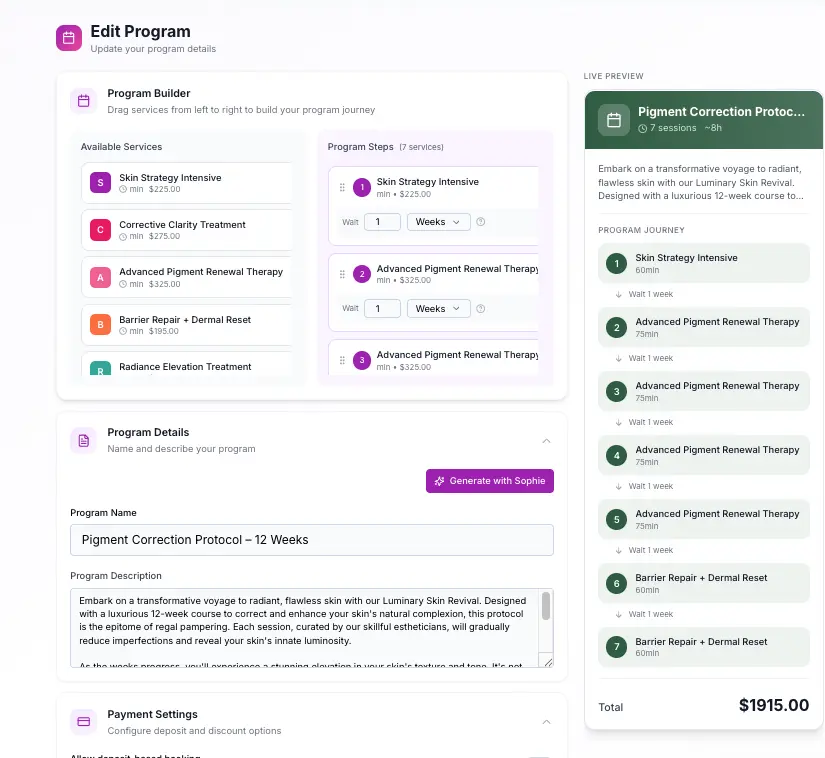
Build multi-session treatment plans with a minimum wait between sessions and progress tracking. Once a wait has passed, your client gets a 'Your Next Session is Ready' email and a Book button on her portal.
Analytics Dashboard
Track revenue per service, service margins, and client lifetime value so you can see which services drive profit.
Online Payments
Take full payment when she enrolls, or let her start with a deposit (a fixed amount or percentage) and pay the rest later.
Frequently asked questions
Does treatment plan pricing mean I have to discount my facials?
Not meaningfully. A 10-15% treatment plan discount buys a committed series of sessions and fewer visits you have to re-sell one at a time. Check the per-session price against your floor so the plan still covers your costs.
What if clients do not want to commit to multiple sessions?
Keep à la carte options available - not every client is ready for a treatment plan. But present the treatment plan first during consultations. When clients see a clear plan with phased outcomes and a bundled price, some will choose the treatment plan over a single session. The ones who do not still book individually.
How do I handle refunds if a client wants to quit mid-program?
Set a clear treatment plan agreement at enrollment: completed sessions are billed at full à la carte rate, and the remaining balance is refundable. This protects you financially while giving clients confidence that they are not locked into something inflexible.
Can I combine treatment plan pricing with memberships?
Yes. Treatment Plans are finite (a defined number of sessions for a specific outcome), while memberships are ongoing (one session per month at a locked rate). A client might complete an acne treatment plan and then convert to a maintenance membership. The two models complement each other.
Related tools
More growth guides
Carry today's treatment into her next visit.
SpaSphere keeps your assessment, treatment plan and home-care recommendations with your client, so the next appointment starts where this one ended.