The Frustration You Know Too Well
You are doing the extractions. You are applying the right acids. You are following the protocol step by step. But your acne clients keep coming back with the same breakouts, the same frustration, and the same question: "Why isn't this working?"
The frustration is real -- for you and for them. You know your technique is sound. You have invested in education, in products, in the right tools. And yet some clients plateau, relapse, or quietly stop rebooking because they are not seeing the progress they expected.
The problem is rarely your skill. More often, it is the approach.
The Protocol Isn't the Problem -- the Approach Is
Most estheticians are trained to treat acne as an isolated condition. See breakouts, attack breakouts. Extractions, peels, benzoyl peroxide, salicylic acid, repeat. It makes sense on the surface.
But acne rarely has a single cause. It often shows up alongside barrier damage, inflammation, hormonal shifts, and lifestyle triggers that vary dramatically from client to client. When you treat only the visible breakout without addressing what is driving it underneath, you create a cycle: temporary clearing followed by relapse, followed by stronger interventions, followed by more damage.
This is why the client who has been to three other estheticians before you is still breaking out. Everyone treated the symptom. Nobody addressed the system.
A one-size-fits-all acne protocol assumes every breakout has the same cause. In reality, a 19-year-old with hormonal cystic acne along the jawline needs an entirely different strategy than a 42-year-old with comedonal congestion on the forehead triggered by stress and barrier compromise. Treating both the same way means at least one of them will not improve.
Barrier Damage Disguised as Acne
Here is one of the most common scenarios that goes unrecognized: the client whose barrier is compromised, and the inflammation that causes is being mistaken for active acne.
Aggressive acne protocols -- strong chemical peels, multiple active ingredients layered daily, retinoids at high percentages without adequate recovery time -- can strip the skin's protective barrier. The skin responds with redness, sensitivity, dehydration, and yes, more breakouts. Irritated skin can break out more, not less. You end up chasing the very problem your protocol is creating.
Signs that you are dealing with barrier damage rather than (or alongside) persistent acne:
- Redness that persists between treatments, not just immediately after
- Increased sensitivity -- products that were tolerated before now sting or burn
- Dehydrated skin that is still oily -- the skin overproduces sebum to compensate for lost moisture
- Breakouts that look inflamed but lack the comedones you would expect with classic acne
If you see this pattern, adding more acids or stronger peels will make it worse, not better. The barrier needs to be repaired before any targeted acne intervention can work.
Start with Analysis, Not Assumptions
Every acne client who sits in your chair needs a thorough skin analysis before you plan a single treatment. This sounds obvious, but in practice it is often skipped or rushed -- especially when the client arrives saying "I have acne, I need a facial" and you have 60 minutes on the clock.
Slow down. Look beyond the lesion count. Observe texture, hydration levels, inflammation patterns, and how the skin responds to touch. Is the redness localized or diffuse? Is the skin tight and dehydrated under that oily surface? Are the breakouts primarily comedonal, inflammatory, or cystic?
Then ask the questions that most estheticians skip:
- What does your current home care routine look like?
- Have you recently changed any products or added new actives?
- How would you describe your stress levels right now?
- Do your breakouts follow any pattern related to your menstrual cycle?
- Are there any foods that seem to make your skin worse?
- How much water are you drinking? How much sleep are you getting?
These are not filler questions. They are data points. Every decision you make about this client's treatment should begin with analysis, not assumption. A client who is breaking out because of over-exfoliation at home needs a fundamentally different plan than a client whose acne flares with every menstrual cycle.
Build a Treatment Path, Not a Single Treatment
Once you understand the full picture, you can design a treatment path -- a phased approach that addresses root causes before attacking symptoms.
Phase 1: Barrier Stabilization (2-4 Weeks)
Strip back aggressive actives. Focus on gentle cleansing, barrier-repair ingredients (ceramides, niacinamide at 2-5%, centella asiatica), and hydration. This phase feels counterintuitive -- you are not "treating the acne" yet. But you are creating the conditions where treatment can actually work.
Explain this to your client. When they understand that a strong barrier is the foundation for clear skin, they trust the process instead of feeling like nothing is happening.
Phase 2: Targeted Acne Intervention (4-8 Weeks)
With the barrier intact, you can introduce targeted treatments -- appropriate-strength peels, LED therapy, controlled use of salicylic or azelaic acid. The skin can now tolerate these interventions without spiraling into inflammation. Results come faster and last longer because the foundation is solid.
Phase 3: Maintenance and Prevention (Ongoing)
Acne management does not end when the skin clears. This phase focuses on maintaining barrier health, managing triggers, and adjusting home care seasonally. Clients who reach this phase with you have every reason to stay -- because you gave them lasting results, not a temporary fix.
This phased approach is built for better long-term results AND better retention. A client who commits to a 12-week treatment path is not shopping around. She is invested in the outcome you mapped out together.
The Gap Between Knowing and Doing
This is where most estheticians struggle – not with knowledge, but with structure.
It is one thing to know you need a 3-phase plan. It is another to consistently execute it across 10–20 acne clients, each with different triggers, timelines, and adjustments. When you are managing it all in your head or on scattered notes, things fall through the cracks. You forget what you changed last session. You lose track of which phase the client is in. The plan drifts.
This is exactly why treatment plans matter. Instead of treating each visit as a standalone appointment, a structured treatment plan lets you map out the full 8–12 week journey – including treatments, home care adjustments, and check-ins – so both you and your client know what comes next.
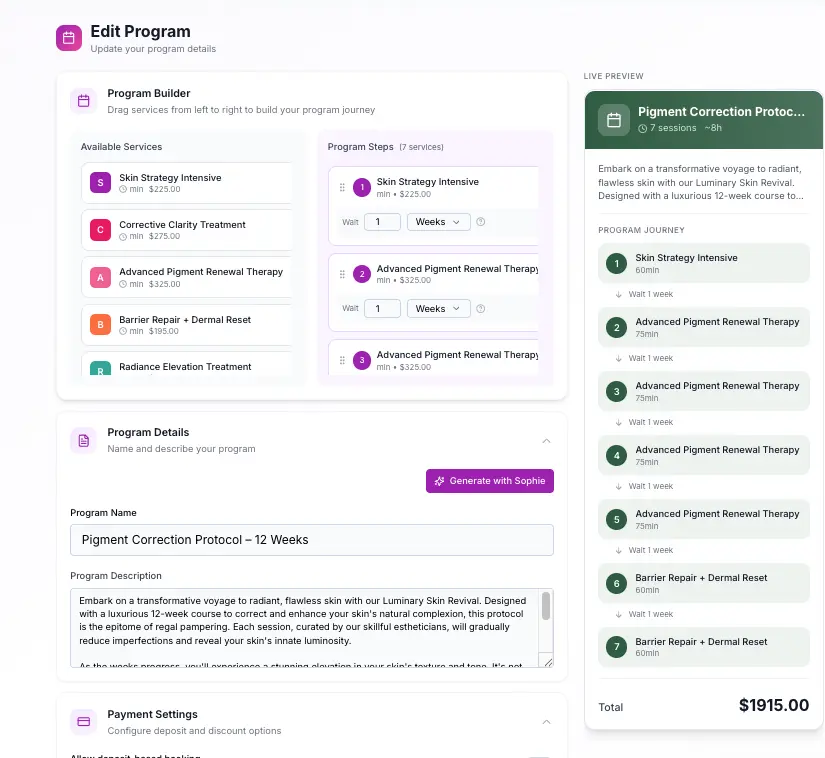 Instead of guessing each session, you map the full journey – so both you and your client know what comes next.
When clients can see the path, they commit to it.
Acne results don't come from a single treatment. They come from a structured treatment plan – one that both you and your client can follow session by session.
Track What Changes
Here is where most estheticians lose the thread. You do a great intake, you design a smart plan, you execute it well -- but you do not systematically track what is working and what is not across multiple visits.
When you rely on memory, you miss patterns. Did the breakouts improve after you added niacinamide in session two, or was it the dietary change she made the same week? Was the flare-up at session four related to stress, her menstrual cycle, or the peel you performed?
You need data across four to six visits to see the real patterns. Use Skin SOAP notes to document each session -- what was done, what products were used, how the skin responded, and what to adjust next time. Note what the client reported about their home care, lifestyle, and any changes since the last visit.
This documentation does three powerful things:
- It makes you a better clinician. Patterns emerge from written records that you will never catch from memory alone.
- It builds client trust. When you pull up their notes and say "Last time we noticed your skin responded really well to the centella mask – let's build on that," the client feels seen and cared for.
- It protects your business. If a client questions a treatment or has an adverse reaction, detailed notes are your professional safety net.
When you combine structured treatment plans with consistent documentation, patterns become obvious. You stop relying on memory and start making decisions based on real client data – across multiple sessions, not just one. That is the difference between treating acne and actually solving it.
The Shift That Changes Everything
The estheticians who get consistently great acne results are not using secret products or revolutionary techniques. They are doing something simpler and harder: they are treating the whole picture, not just the breakout.
They start with analysis. They repair before they attack. They build phased treatment plans. And they track everything so they can adjust with precision instead of guessing.
This is where many acne treatments break down – not in the treatment room, but between visits. Without a structured treatment plan, every appointment becomes reactive. You adjust, guess, and hope you are moving in the right direction.
With treatment plans, you stop guessing. You map out the full acne journey – barrier repair, targeted treatment, and maintenance – and track progress session by session. Each visit builds on the last, instead of starting over. Combined with Skin SOAP notes and full client history, you can see exactly what is working, what is not, and adjust with precision.
That is how you move from "trying things" to actually clearing skin.
Still managing acne clients session by session? Build structured treatment plans with built-in documentation and track progress across every visit.