You Built the Menu. Clients Are Not Using It.
You spent weeks building your treatment menu. It has options for every skin type, every concern, every budget. There is an express facial, a classic facial, a deep cleansing facial, a hydrating facial, a brightening facial, an anti-aging facial, and three different peel options. You thought more choices meant better service.
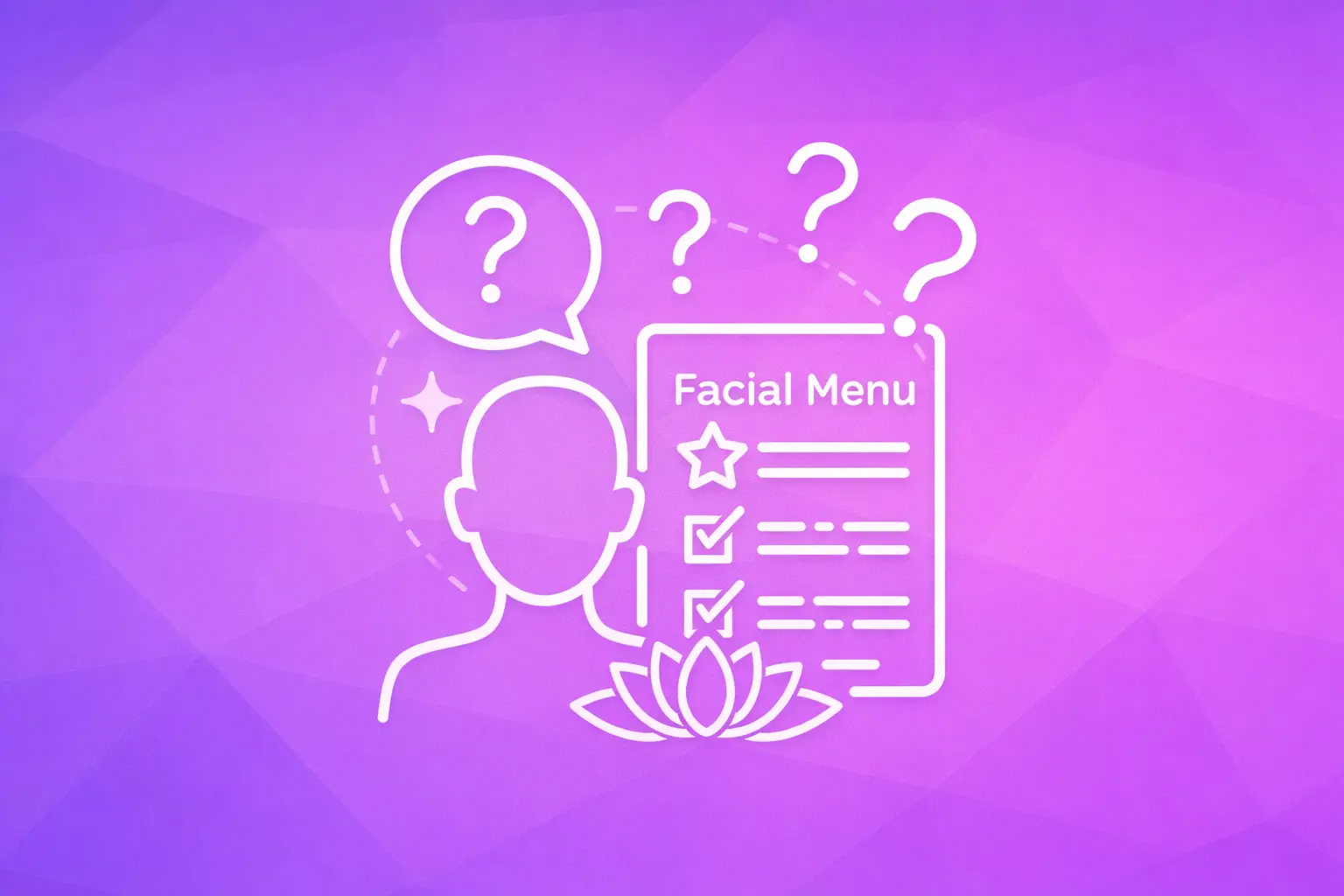
But when a new client lands on your booking page, they freeze. They scroll up and down. They open two service descriptions in different tabs. They cannot tell the difference between your Glow Facial and your Radiance Facial. So they do the one thing you did not plan for: they leave without booking.
This is not a marketing problem. It is not a pricing problem. It is a menu design problem, and it is more common than you think.
A client who cannot decide does not book a less appealing option. They book nothing at all.
The Paradox of Choice on Your Booking Page
More options can lead to fewer decisions. When people face too many similar choices, they experience decision fatigue. Instead of feeling empowered, they feel overwhelmed. Instead of picking something, they postpone the decision entirely.
This plays out on spa booking pages every single day. A potential client who is ready to spend $150 on a facial will abandon the booking flow if she cannot figure out which of your eight facials is right for her. She does not default to the cheapest one. She does not call you for guidance. She closes the tab and scrolls to the next spa on Google that makes the decision easier.
If your facial category alone has 10+ services, it is worth asking whether you are losing bookings to confusion.
Signs Your Menu Is Working Against You
You might not realize your menu is the bottleneck. Here are the signals that usually point to a design problem, not a demand problem:
- Clients regularly ask "what's the difference between X and Y?" This is the clearest sign. If clients cannot distinguish your services from the descriptions alone, the descriptions are not doing their job.
- Your most profitable services are buried. Your $165 signature facial is listed seventh on the page, below five cheaper options. Clients never scroll that far.
- You cannot explain every service in one sentence. If it takes a paragraph to differentiate two services on your menu, they are too similar. Merge them or cut one.
- New clients default to the cheapest facial. Not because they want the cheapest option, but because it feels like the safest choice when everything else is unclear.
- You get pre-booking questions constantly. Emails, DMs, and phone calls asking "which treatment should I get?" are not a sign of engaged clients. They are a sign of a confusing menu.
Each of these symptoms drains your time and your revenue. Every question you answer manually is time you could have spent treating someone. Every abandoned booking is revenue you will never recapture.
How to Restructure Your Menu for Clarity
The fix is not adding better descriptions to a broken structure. The fix is simplifying the structure itself. Here is how to do it:
Tier Your Services (Three Tiers Maximum)
Every facial on your menu should fit into one of three tiers:
- Entry -- Your introductory facial. Lower price point, shorter time, ideal for new clients or quick maintenance visits. One option, not three.
- Signature -- Your core offering. This is the facial you are known for, the one that represents your clinical philosophy. It should be where 60-70% of your bookings land. One option.
- Premium -- Your most advanced, most customized, highest-priced treatment. Reserved for clients who want the full experience. One option.
Three tiers. Three facials. That is your core menu. Each tier has a clear price gap between them so clients understand the difference at a glance. If your entry facial is $85, your signature is $145, and your premium is $210, the value progression is obvious without any explanation needed.
For a deeper look at how tiered pricing compares to time-based pricing, read our breakdown on tiered vs. time-based pricing models.
Use Add-Ons for Customization Instead of Separate Services
This is the key shift that simplifies everything. Instead of creating a separate "Hydrating Facial" and "Brightening Facial" and "Anti-Aging Facial," you create one signature facial and let clients (or you, during the consultation) customize it with targeted add-ons.
This approach gives clients the personalization they want without the decision fatigue of parsing ten different service descriptions. It also makes your operations cleaner and your booking page significantly easier to navigate.
Write Descriptions That Answer Four Questions
Every service description on your menu should answer:
- Who is this for? "Ideal for clients dealing with dehydration, sensitivity, or post-treatment recovery."
- What does it include? "Enzyme exfoliation, barrier-repair mask, LED therapy, and customized serum infusion."
- How long does it take? "75 minutes."
- What result should I expect? "Your skin will feel calmer, more hydrated, and visibly less reactive within 24 hours."
If your current descriptions are just a list of steps (cleanse, steam, extractions, mask, SPF), rewrite them around outcomes. Clients do not care about your process. They care about what their skin will look and feel like when they leave. For more on writing service descriptions that convert, check out our guide on designing a spa menu that sells itself.
Add-Ons Are Your Secret Revenue Weapon
Instead of fifteen different facials, build a menu with three core facials and five to eight add-ons. Add-ons feel like customization to the client. To you, they are incremental revenue with minimal extra time or product cost.
Here are add-ons that work well in practice:
- LED light therapy -- $25-$35, runs during an existing mask step, near-zero product cost.
- Dermaplaning -- $30-$40, 15 minutes, high perceived value.
- Enzyme or peel boost -- $20-$25, swapped in during the exfoliation step, no extra time.
- Lip or eye treatment -- $15-$20, applied during mask time, no extra time.
- Gua sha or facial sculpting -- $25-$35, 10 minutes, no consumable cost.
Now do the math. If you see 80 clients per month and 60% of them add one $25 add-on, that is $1,200 per month in additional revenue with almost no additional cost. Over a year, that is $14,400 from a simple menu restructure.
Add-ons also give returning clients a reason to try something different each visit without you needing to create a whole new facial for them. Last month she added LED. This month she wants the enzyme boost. Same core facial, different experience, higher ticket.
Your Booking Page Is Your Menu
Here is a truth that many estheticians overlook: for many of your clients, your online booking page is the only menu they will ever see. They will never walk into your treatment room, pick up a printed menu, and browse your offerings in person. The decision happens on their phone, usually late at night or during a lunch break, in a minute or two.
If that minute presents 20 confusing options with vague descriptions, you lose the booking. If it presents three clear tiers with benefit-driven descriptions and optional add-ons, you win the booking.
This means your online booking experience needs to be designed like a sales page, not a spreadsheet. SpaSphere's online booking system lets you organize services into clean tiers, display add-ons contextually when a client selects a service, and present everything on a page that looks like it was designed by a professional, because it was.
Your website builder works hand-in-hand with your booking flow. When a client visits your site, they see your services presented clearly. When they click "Book Now," the transition is seamless. No friction, no confusion.
A Simpler Menu Builds More Trust
A confusing menu does not just lose bookings. It quietly erodes trust. When a client cannot understand your offerings, they start to wonder if you fully understand them either. A scattered menu signals a scattered business.
On the other hand, a clean, focused menu communicates confidence. It says: "I know exactly what I do, I do it exceptionally well, and I have made it easy for you to say yes."
That clarity extends to every touchpoint. When a client asks a friend for a recommendation, they do not say "she has like fifteen facials, I'm not sure which one I got." They say "she has this incredible signature facial, you need to try it." A simple menu makes you referable.
Your menu should not try to say everything. It should say the right thing clearly enough that a new client books within 60 seconds of reading it.
A Weekend Menu Audit
You do not need to hire a consultant or shut down for a week. You can restructure your menu in a focused afternoon:
- List every facial you currently offer. Write down how often each one was booked in the last 90 days.
- Identify the bottom performers. Any facial booked fewer than 5 times in 90 days gets cut or merged into another service.
- Assign tiers. Choose your Entry, Signature, and Premium facial. Everything else either becomes an add-on or disappears.
- Rewrite three descriptions. One per tier. Answer the four questions: who, what, how long, what result.
- Update your booking page. Reorganize your services in SpaSphere, add your add-ons, and publish. Use the analytics dashboard to track bookings over the next 30 days and compare.
FAQ
Q: Won't I lose clients if I remove services from my menu? A: The services you remove are almost certainly your lowest-booked options. Clients who wanted those treatments can usually be served by your core facials with the right add-ons. You are likely to gain more bookings from clarity than you lose from reduced options.
Q: How many add-ons is too many? A: Five to eight add-ons is a good range. Beyond that, you start recreating the same decision fatigue problem in a different form. Keep add-ons focused on distinct benefits so clients can quickly identify which one is relevant to them.
Q: Should I show add-ons on my booking page or only suggest them in person? A: Both. Show them on your booking page so self-directed clients can add them before they arrive. Then suggest the most relevant one during the consultation for clients who did not pre-select. This double touchpoint captures both types of buyers.
Q: What if I specialize in multiple modalities and want to show them all? A: Your modalities are your toolkit, not your menu. Use them within your three-tier framework. A signature facial can incorporate microcurrent, LED, chemical exfoliation, and lymphatic drainage depending on the client. You do not need a separate listing for each modality.
Organize your services into clear tiers, add customizable add-ons, and present a booking page that converts browsers into booked clients.