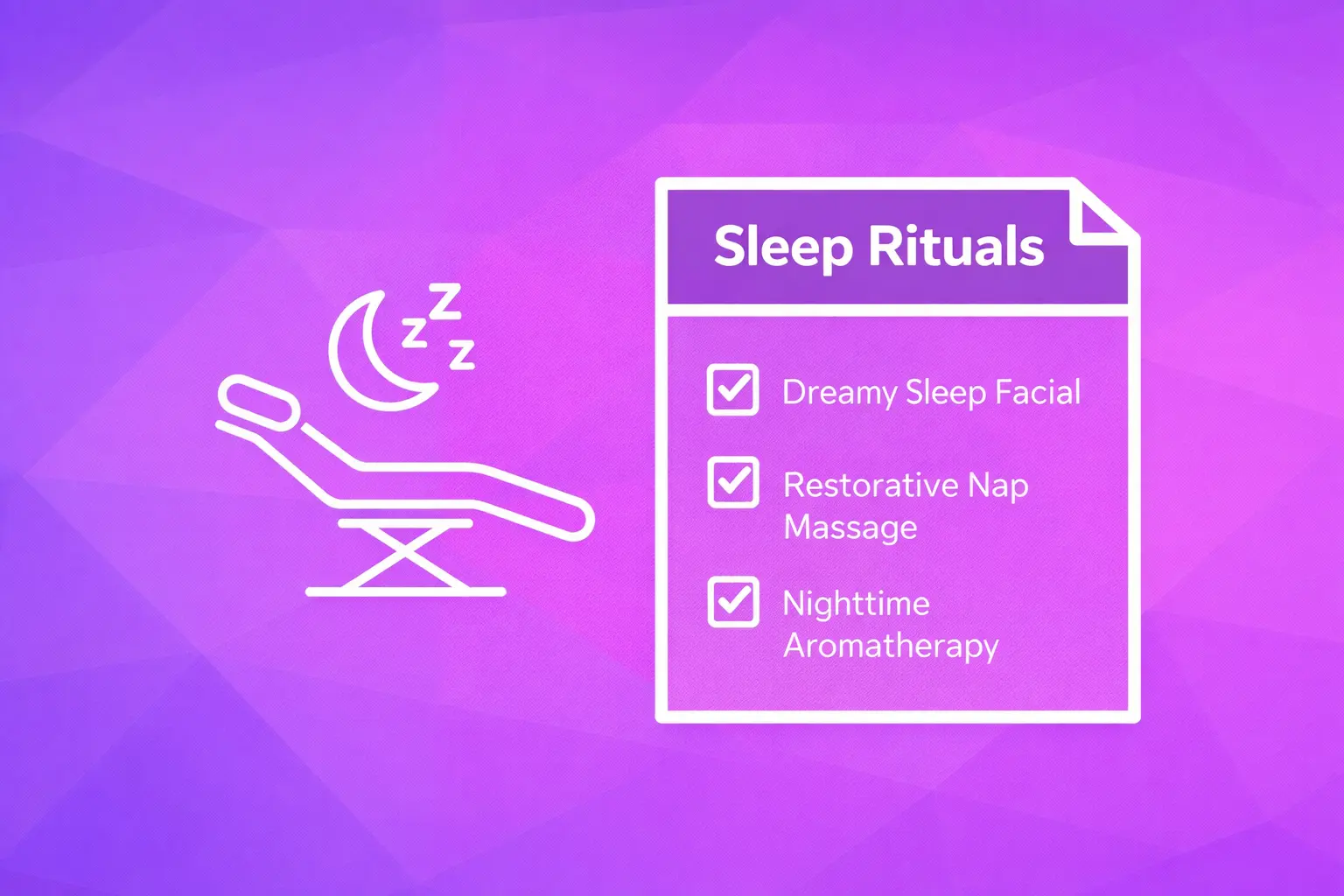
Adding sleep-focused treatments to your menu does not require new certifications, expensive equipment, or a complete rebrand. It requires intention -- taking what you already do well and framing it around the outcome your clients want most: rest.
If you have read about the sleepmaxxing trend and wondered how to actually put it into practice, this is the playbook. We will start small, scale up, and show you exactly where the revenue comes from.
Start with Add-Ons, Not Standalone Services
The fastest way to test sleep-positioned services is to layer them onto what you already offer. Do not overhaul your menu. Just add intentional wellness enhancements to your existing treatments.
During facial mask time:
- Guided breathing exercise (3-5 minutes of slow, counted breathwork)
- Weighted eye mask placement (gentle, even pressure)
- Extended scalp massage with calming essential oils
Post-treatment ritual:
- Warm herbal tea served slowly, not rushed
- Gradual transition back to awareness -- dim lighting, soft voice, no sudden overhead lights
- Intention card or "evening ritual" recommendation card the client takes home
These add-ons require 10 to 15 extra minutes at most and justify a $20 to $35 increase on the ticket. The product cost is negligible. The perceived value is significant because you are giving the client an experience that feels complete, not transactional.
The key is framing. Do not list these as "extras." Present them as part of a wellness enhancement -- a deliberate upgrade that transforms a standard treatment into a restorative experience. For more on how to present service upgrades effectively, see our guide on the gentle upsell approach.
Build a Sleep-Focused Signature Treatment
Once your add-ons prove popular -- and you will know quickly, because clients will ask for them by name -- it is time to create a dedicated experience.
Example: "Deep Rest Facial" -- 75 minutes
- Extended double cleanse with warm compresses (setting a slow, intentional pace from the first touch)
- Slow facial massage using a custom aromatherapy blend -- lavender, chamomile, and cedarwood
- Sound healing element during mask time (a single singing bowl or tuning fork played at intervals)
- Scalp and neck massage with gentle, sustained pressure
- Warm herbal foot wrap to close the session
Price this 25 to 40% above your standard facial. The extended time, the sensory depth, and the outcome-focused positioning justify the premium. A facial that sells for $125 becomes a Deep Rest Facial at $165 to $175. Clients who are serious about rest tend to accept that price point because you are offering an experience built around the outcome they want.
This is exactly how signature treatments build brand differentiation. You are not competing on price or technique. You are competing on experience -- and that is a category where solo and boutique spas have a natural advantage over chains.
The Sensory Environment Matters
The treatment itself is only part of the equation. The room sets the tone before you ever touch the client.
Small changes that cost almost nothing but transform perceived value:
- Lighting -- warmer tones, lower intensity. Avoid overhead fluorescents entirely. A $15 salt lamp or warm-toned LED does the job.
- Sound -- nature sounds, low-frequency tones, or intentional silence. Not pop music, not a generic spa playlist. The sound environment should feel deliberate.
- Scent -- diffuse calming essential oils 15 minutes before the client enters. The room should already feel like rest when they walk in.
- Temperature -- slightly warm, with a blanket available. Cool rooms trigger alertness. Warmth signals safety.
These sensory details are what clients remember and talk about. They are also what makes a sleep-focused treatment feel fundamentally different from a standard facial with a few upgrades tacked on.
Create a Sleep Treatment Plan, Not Just a Single Treatment
Individual treatments get clients in the door. Treatment Plans keep them coming back -- and create the kind of recurring revenue that makes your monthly income predictable.
Example: "Sleep Reset" -- 4-session treatment plan, one treatment per week for a month
- Session 1: Deep Rest Facial with full aromatherapy and sound healing introduction
- Session 2: Scalp and neck intensive with warm stone placement and extended breathwork
- Session 3: Remineralizing body wrap with magnesium salts and guided relaxation
- Session 4: Integration session -- combines the client's favorite elements from sessions 1-3
Each session builds on the previous one, gradually deepening the client's relaxation response. By session 3, ask how quickly she is falling asleep and how rested she feels in the morning, and note what she tells you.
Include a home care protocol with each treatment plan enrollment:
- Bedtime ritual guide (a simple one-page recommendation for wind-down practices)
- Retail products selected for that client (pillow spray, bath salts, aromatherapy roller)
- Optional journaling prompts focused on gratitude and evening reflection
Treatment Plans create recurring revenue, better outcomes, and higher lifetime value. A client who buys a single facial might come back in six weeks. A client enrolled in a treatment plan is booked for four consecutive weeks -- and a client who has felt the difference has a reason to continue with maintenance visits.
For a deeper look at structuring multi-session offerings, read our guides on treatment plans for estheticians and goal-based treatment plans.
Revenue Projection
Here is an example of what the numbers could look like when you layer sleep rituals across your business. Swap in your own prices and client count:
Sleep add-on: $25 average price with a 50% attach rate across 80 monthly clients = $1,000/month
Sleep facial (standalone): $175 per session, 10 clients/month = $1,750/month
Sleep retail: Average $30 purchase per sleep-facial client = $300/month
Sleep treatment plan (4 sessions at $625): 3 treatment plan enrollments/month = $1,875/month
Total in this example: $3,000 to $5,000 per month in new revenue from a single positioning shift.
That is $36,000 to $60,000 annually -- from services that require no new equipment, no additional certifications, and minimal incremental product cost. The investment is your time in designing the experiences and training yourself to deliver them with intention.
In this example, a sleep menu adds $3,000 to $5,000/month. Run it with your own prices and client count before you plan around it.
Launch Your Sleep Menu
You do not need to roll out everything at once. Start with two or three add-ons this week. Track which ones clients request most. Build your signature treatment around the winners. Then package a treatment plan once you have the confidence and the data.
SpaSphere lets you build multi-session treatment plans, track client progress, manage retail inventory, and automate follow-ups -- everything you need to launch sleep rituals as a revenue category. Add sleep-focused services to your online booking page, and let clients self-select into the experiences that resonate with them.
The demand is already there. Your clients are searching for better rest. All you need to do is show them you have the answer.